
For many Bay Area properties, refinishing is the more practical and economical choice. Professional sanding can remove years of scratches, worn coatings, discoloration, and surface damage, creating a clean surface for stain and a new protective finish. But there are circumstances where replacement is the responsible recommendation. A professional assessment helps determine whether the floor needs restoration, localized repair, or complete replacement.
When Refinishing Is the Right Investment
Refinishing is most effective when a genuine wood floor is fundamentally sound but its surface and finish have become worn. Scratches, dull traffic paths, faded areas near windows, minor pet damage, and old ambered finishes are common reasons to refinish rather than replace. In many cases, these problems affect the finish and upper surface of the wood rather than the structural integrity of the flooring.
Solid hardwood is particularly well suited to restoration. Depending on its original thickness, previous sanding history, and current condition, a solid hardwood floor can often be refinished multiple times during its life. Professional sanding removes the old finish and enough wood to produce a clean, flat surface without unnecessarily reducing the thickness of the flooring.
Once properly sanded, the floor can retain its natural appearance or be stained to change its color. Homeowners with older orange, red, or heavily ambered floors are often surprised by how dramatically refinishing can update a room without replacing the wood.
Refinishing can also preserve features that may be difficult or expensive to reproduce. Older oak, maple, and other hardwood floors often have distinctive grain, board dimensions, and natural variation. In older homes throughout San Francisco, Oakland, San Jose, and surrounding Bay Area communities, restoring the original hardwood can preserve an important feature of the property.
The practical advantages extend beyond appearance. Keeping an existing floor avoids unnecessary demolition and disposal and generally costs substantially less than removing a sound hardwood floor and installing a new one.
Repairs Can Often Be Made Before Refinishing
A hardwood floor does not need to be perfect before it can be refinished. Loose or damaged boards, isolated stains, small damaged sections, and other localized problems can often be addressed before the entire floor is sanded.
Individual boards may be replaced or repaired and then blended into the surrounding flooring during the refinishing process. National Floors regularly performs hardwood floor repairs as part of larger restoration projects when replacing an entire floor would be unnecessary.
The important issue is determining why the damage occurred. If a dishwasher leak, plumbing problem, pet damage, or moisture from below has affected a limited area, the source of the problem should be corrected before the floor is restored.
Sanding away the visible evidence without correcting an active moisture problem can result in recurring stains, cupping, movement, or additional damage.
When Replacing Hardwood Floors Makes More Sense
Replacement becomes the better option when the existing flooring no longer has enough usable wood to sand safely, has extensive structural deterioration, or has widespread damage that makes restoration impractical.
Severe termite damage, rot, extensive moisture damage, badly fractured boards, or flooring that has already been sanded too many times can make replacement necessary.
With traditional tongue-and-groove hardwood, previous sanding history matters. Each refinishing removes some material from the top of the board. Eventually, a floor can become too thin above the tongue and groove to tolerate another aggressive sanding. Signs may include exposed fasteners, cracking near the board edges, or a wear surface that has become dangerously thin.
This is one reason an experienced flooring contractor should inspect an older floor before recommending another refinishing.
Water Damage Requires a Different Evaluation
Water-damaged hardwood flooring should be evaluated according to both the severity of the damage and whether the moisture source has been eliminated.
A limited water event does not automatically mean the entire floor needs replacement. Depending on the circumstances, affected boards may dry, flatten, or be replaced individually before the surrounding floor is refinished.
Widespread buckling, severe cupping, damaged subflooring, rot, or continued moisture exposure can create a very different situation. In those cases, sanding the surface may improve appearance temporarily without addressing the actual failure.
Bay Area homes can experience moisture from plumbing leaks, crawl spaces, concrete slabs, exterior water intrusion, or other sources. Before refinishing or installing replacement flooring, the moisture condition should be understood and corrected.
Engineered Hardwood Requires Careful Inspection
Engineered hardwood requires a different evaluation from traditional solid wood flooring. An engineered board consists of a hardwood wear layer over a layered or composite core.
Some higher-quality engineered hardwood floors can be refinished, but the determining factor is the thickness of the usable wear layer. If enough genuine hardwood remains above the core, careful sanding may be possible. If the wear layer is too thin, conventional sanding can expose the material beneath it and permanently damage the floor.
This determination should be made before sanding begins. The fact that a floor looks like solid hardwood from above does not mean it can be treated the same way.
When the wear layer is insufficient or the engineered flooring has widespread damage, replacement may be the safer long-term choice.
Subfloor Problems Can Change the Decision
Sometimes the hardwood itself is not the primary problem. Movement, squeaking, widespread gaps, uneven areas, or recurring moisture issues may originate beneath the flooring.
If the subfloor is damaged, unstable, or affected by moisture, refinishing the surface will not correct the underlying condition. Depending on the severity and accessibility of the problem, sections of flooring may need to be removed so the substrate can be repaired.
This is particularly important when installing over concrete. Moisture conditions must be evaluated before new wood flooring is installed. The flooring material, adhesive system, moisture-control products, and installation method all need to be appropriate for the slab and the flooring being used.
Refinishing Usually Costs Less Than Replacement
When an existing hardwood floor is structurally sound, refinishing is generally less expensive than replacing it. The existing material remains in place, eliminating the cost of purchasing an entire new floor as well as much of the demolition, disposal, and installation labor.
The cost of refinishing still varies according to square footage, repairs, existing coatings, stain selection, stairs, accessibility, and the amount of preparation required.
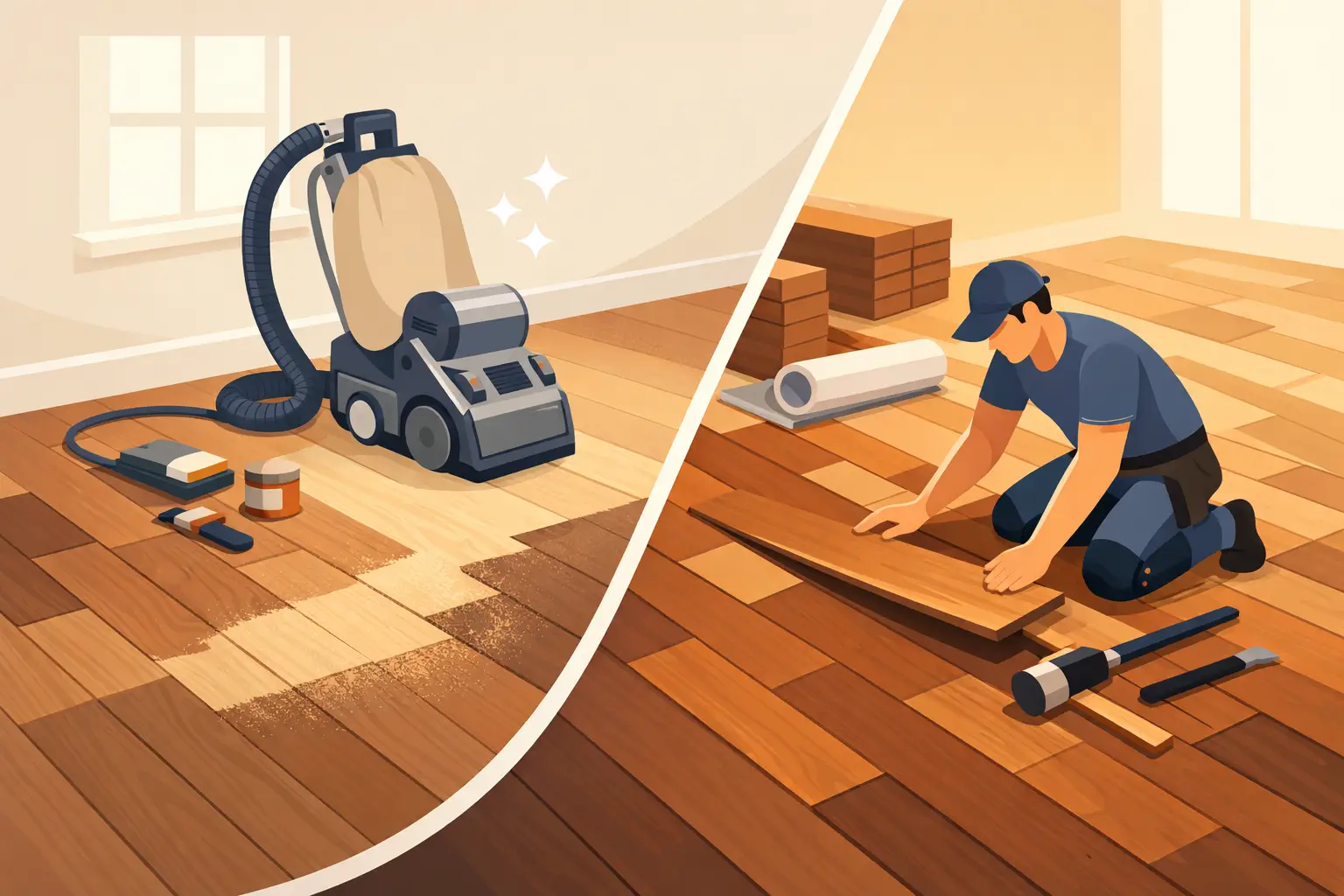
Replacement involves additional variables. The existing flooring may need to be removed and disposed of, the subfloor may require repair or preparation, and new material must be purchased and installed. Baseboards, transitions, stairs, doors, and adjoining flooring can also affect the scope of the project.
For this reason, replacing a hardwood floor that could have been successfully refinished can add considerable expense without necessarily producing a better result.
Refinishing and Replacement Cause Different Types of Disruption
Both options require preparation, but the work involved is different.
Professional refinishing generally includes protecting the work area, sanding the existing flooring, performing necessary repairs, applying stain when selected, and applying the chosen protective finish. Furniture must be removed from the work area, and the floor requires appropriate drying and curing time before normal use resumes.
Replacement adds demolition and removal of the existing flooring, subfloor preparation when necessary, delivery and installation of the new material, and finishing work depending on the type of flooring selected.
Neither process should be rushed. A floor that looks good immediately after completion but later fails because of moisture, improper preparation, or inadequate curing has not been successfully restored.
How a Flooring Contractor Determines Which Option Is Better
The most useful first step is an on-site inspection. Photographs can show scratches, discoloration, and obvious damage, but they cannot always reveal the remaining thickness of the flooring, previous sanding history, subfloor conditions, or the extent of a moisture problem.
A flooring professional can determine whether damage is primarily in the finish, extends into the wood, or involves the structure beneath the flooring. Individual boards and problem areas can also be evaluated to determine whether localized repair would preserve the rest of the floor.
For engineered hardwood, the wear layer must be considered. For older solid hardwood, the remaining material above the tongue and groove becomes important. When moisture is suspected, the source and extent of that moisture should be investigated before restoration begins.
A qualified hardwood flooring contractor should be willing to explain these trade-offs. Refinishing should not be presented as the solution to every damaged floor, and replacement should not be recommended simply because an old finish looks bad.
Refinish When the Floor Is Worth Saving
A hardwood floor can look dramatically worse than its actual condition. Scratches, worn finish, discoloration, old stain, and years of traffic can make a structurally sound floor appear ready for replacement when much of what the homeowner is seeing can be removed during professional sanding.
If the flooring still has sufficient usable wood and the boards and substrate are sound, refinishing can restore the existing hardwood and extend its service life for many more years.
If the floor has extensive structural deterioration, severe moisture damage, insufficient remaining thickness, or conditions beneath it that require major reconstruction, replacement may be the better investment.
National Floors provides hardwood floor refinishing, repair, and restoration throughout the San Francisco Bay Area. An on-site assessment can determine whether your existing hardwood should be repaired and refinished or whether replacement is the more practical long-term solution.
