
The species of wood, the thickness of the wear layer, the condition of the floor, previous sanding, and even the homeowner's desired stain color all play a role in the decision.
Engineered Hardwood Requires Special Consideration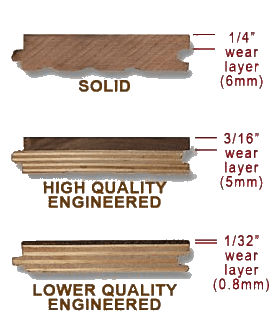
Engineered hardwood flooring presents some of the greatest challenges during refinishing because there is very little room for error. Unlike traditional solid hardwood flooring, engineered flooring contains a real hardwood wear layer bonded to several layers of plywood or composite material.
In general, engineered flooring with a wear layer of approximately 3 millimeters or greater may be considered a candidate for refinishing. However, every floor should be evaluated individually before any sanding begins.
Professional belt sanders used by flooring contractors develop tremendous cutting power. Their job is to flatten the floor by removing the high spots without discrimination. If an operator pauses for even a fraction of a second on a thin wear layer, the sanding drum can leave what flooring professionals refer to as a drum stop mark—a noticeable indentation in the surface.
Because engineered flooring has a limited wear layer, correcting this type of damage often requires replacing the affected boards rather than simply sanding deeper.
Solid Hardwood Floors Offer Greater Refinishing Potential
Traditional solid hardwood flooring is constructed differently. Most solid hardwood floors contain a wear layer of approximately 5/16 inch above the tongue and groove. This provides considerably more material that can be refinished over the life of the floor.
Many solid hardwood floors remain in service for generations and, with proper care and maintenance, may continue performing beautifully for many decades.
During a typical refinishing project, an experienced flooring contractor often removes approximately 1/32 inch of material. That amount varies depending on the condition of the floor and the work necessary to restore it properly.
Every Previous Sanding Matters
No two hardwood floors have the same history.
Some floors have never been refinished. Others may have been sanded several times over the years. In some cases, previous contractors have left behind uneven sanding, chatter marks, drum marks, or waves that must be corrected before a new finish can be applied.
Correcting these conditions sometimes requires removing additional material, which directly affects how much usable wear layer remains.
Your Desired Stain Color Also Matters
Many homeowners are surprised to learn that their stain selection can influence the refinishing process.
Lighter stain colors and natural finishes tend to reveal even the smallest sanding imperfections. Achieving a clean, uniform appearance often requires exceptionally precise sanding because there is very little color available to disguise defects.
Darker stain colors can conceal certain minor imperfections more effectively, although proper sanding remains essential regardless of the final color selected.
Professional Evaluation Is the Only Reliable Answer
There is no universal formula that determines how many times a hardwood floor can be refinished. Every floor is different, and every refinishing project begins with evaluating the floor's condition rather than relying on a predetermined number.
An experienced flooring contractor considers the wood species, remaining wear layer, previous sanding history, structural condition, repairs, moisture damage, and the homeowner's desired appearance before recommending refinishing.
At National Floors, every hardwood floor is evaluated individually before work begins. Our goal is to preserve as much of the original flooring as possible while providing honest recommendations based on the actual condition of the floor rather than relying on industry myths or generalized rules.
